One Character, Every World: How the 59-Second Launch Film Was Cut From Three Seedance 2.5 Clips
The film that announced GPT Image 2.5 on Gendia is two 30-second Seedance 2.5 renders from one portrait, a 5-second portal that joins them, and an edit. The three prompts in full, the cut map, what it cost, and the accident that produced the middle act.
The 59-second film that announced GPT Image 2.5 on Gendia is three Seedance 2.5 clips and an edit: two 30-second renders from one portrait, a 5-second render that bridges them, and interface bars composited on top. 1080p, 16:9, audio on, 21,450 credits for the footage that is on screen. The middle act came from a 185-word prompt that was pasted on its own by mistake and rendered anyway.
What Went In
| Clip | Prompt | Length | Credits | Used in the cut |
|---|---|---|---|---|
| Time travel (Egypt → Venice → 1920s → home) | 1,729 words, 1 portrait | 30 s | 9,900 | 0–26 s and 50–55 s |
| The accident (alley → portal → jungle → neon city) | 185 words, 1 portrait | 30 s | 9,900 | 31–50 s |
| Portal bridge (doorway → wet close-up) | 166 words, first + last frame | 5 s | 1,650 | 26–31 s |
All three are Seedance 2.5 at 1080p with audio, no input video. The only image reference in the two long clips is the same frontal portrait.

The Cut Map
The film runs in five pieces. Seconds are from the finished edit.
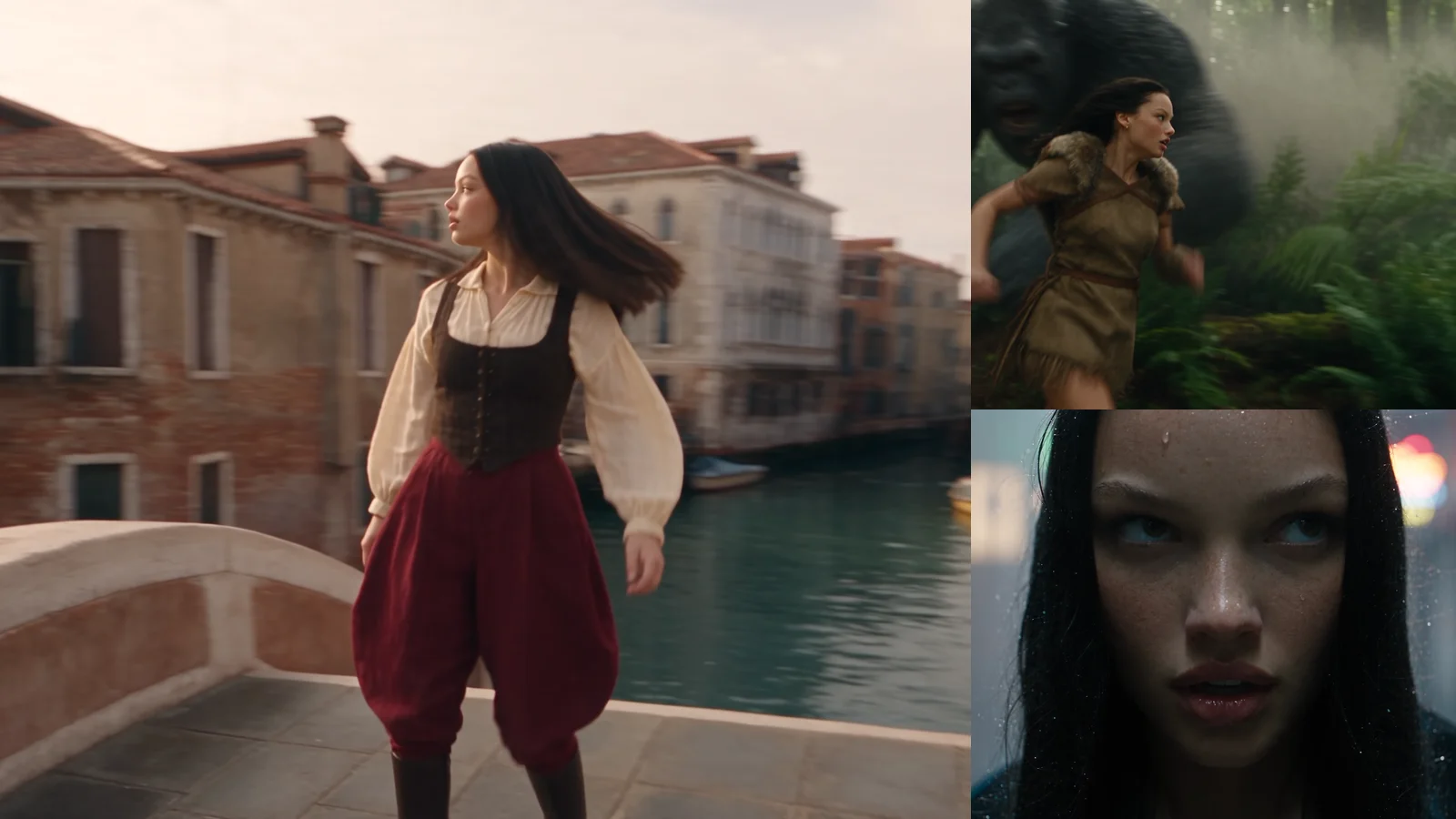
0–26. The time-travel clip, from its first frame: wet modern street, the van becomes a carriage, the staircase to Egypt, the Venice bridge, the 1920s courtyard, the sweep toward the doorway. Prompt bars appear over it, Take me to ancient Egypt, Give me an ivory dress, Take me to Venice, Take me to an old town.
26–31. The portal bridge. The doorway opens onto a rainy neon alley; she walks through and her waistcoat becomes a black leather jacket; the camera settles on a wet close-up.
31–50. The accidental clip, from about its first second: the wet close-up, the alley run, a column of light, the jungle with a creature behind her, an escape portal. Bars: Make it a survival story, Add a jungle monster, Open an escape portal.
50–55. Back to the time-travel clip's last five seconds: she steps home through the shop window in the adventure outfit, on the same street as the opening. Bar: Take me back to the start.
55–59. End card over her opening walk.
Nothing in the film is a whole render. The longest continuous piece of any clip is 26 seconds.
Clip 1: The Time-Travel Film
This is the clip the film was planned around, and the prompt is built like the jacket film and the rescue film before it: rules first, then scenes with second ranges.
Identity, once. The portrait is the sole face reference. Long, loose, dark, centre-parted hair; her outfits change between eras; her face and hairstyle do not.
The final outfit, from text. Olive tank top, weathered utility shorts, knee-high buckle boots, shoulder harness, thigh pouches, cream socks. The prompt says these come from an attached outfit collage; no collage was attached. The model built the outfit from the sentence, and it is on screen at second 50.
Six timed blocks. 0–4 the van becomes a carriage and she says Wait… what?; 4–8 the shop window shows a sandstone courtyard and the pavement becomes a staircase; 8–14 Egypt, a market awning wipes the lens, she throws a palm forward and the folding stones stop; 14–20 Venice, a half-orbit on the bridge, a jump onto a boat; 20–25 1920s New York, a luggage trolley to swing around, her palm stops the shifting world; 25–30 home through the window in the new outfit, Okay. My turn.
A paragraph for the edit. UI, added later in editing. Generate clean cinematic footage only. Keep her deliberate hand gestures fully visible, with uncluttered space beside her hand for later UI placement. Every prompt bar in the finished film sits in that space.


The connective tissue landed as written: the staircase into Egypt, the awning across the lens, the bridge, the trolley, the window home. The van-to-carriage change happens in the first two seconds with the wheels on the curb line.
Clip 2: The Accident
Thirty-five minutes before the time-travel render, a different message was sent as a prompt. It reads, in full, Add this at the very beginning of the prompt, replacing the existing character-reference section, followed by the 185-word identity block. No scenes, no eras, no locations. It was a note about the prompt, not the prompt, and it went to the model with the portrait attached.
Seedance 2.5 rendered 30 seconds from it. A wet close-up in the rain, a run down a neon alley in a black leather jacket, a column of light, a jungle with a creature behind her in a fur-trimmed tunic, an escape portal, and a neon future city in a light-lined suit.


The identity block alone was enough for the face. The clip has the same woman as the time-travel render, in worlds nobody wrote. Nineteen of its thirty seconds are the middle act of the film. The last eleven, the neon city, were cut because they did not lead anywhere the story needed to go.
Clip 3: The Bridge
The time-travel clip ends in 1920s New York with her hand sweeping toward a doorway. The accidental clip starts on a wet face in a neon alley. Those two frames are the start and end of a five-second first-and-last-frame render.

The prompt is 166 words: she completes the sweep, her fingertips light an amber seam around the door, the door opens onto the rainy alley, she steps through in one push-in, the waistcoat becomes the leather jacket during the crossing, rain on her hair, the camera settles into the exact wet face close-up of the end frame. Door creak, portal whoosh, rain, a distant creature rumble. No speech, no music.

Seedance 2.5 arrives on the end frame precisely, which is what makes the cut into clip 2 invisible. The outfit change happens in the light of the doorway where nobody can check it.
Step-by-Step: Build a Long Film From Short Renders
Step 1: Lock one portrait
One frontal image, plain background, face forward. Attach it to every render that has the character in it. Do not attach a different photo per clip; the point is that the model reads identity from one source.
Step 2: Write the spine as timed scenes
Six blocks with second ranges. Each block names the world, the outfit, one physical action, and the thing that carries her out, stairs, a folding floor, a boat, a ramp, a window. Transitions written as actions cut better than transitions written as effects.
Step 3: Leave room for the interface
If graphics are going on top afterwards, say so: no UI, no captions, hands fully visible, empty space beside the gesture. The model composes the shot around the gap and the bars drop in without covering anything.
Step 4: Bridge clips with a first-and-last-frame render
Export the last good frame of one clip and the first frame of the next. Attach them as start and end, describe the crossing in one paragraph, and render five seconds. Say the exact close-up of the end frame so the model lands on it rather than near it.
Step 5: Cut for the story
A 30-second render is raw material. Use the run of it that works, drop the run that does not, and come back to the first clip for the ending if that is where the ending is. This film uses 26 seconds of one clip, 19 of another, 5 of the bridge, then 5 more of the first.
The Prompts
Three prompts, in the order they run in the film. Recreate opens each in the video generator with Seedance 2.5 selected; attach your own portrait, or your own two frames for the bridge.
Clip 1: the time-travel film. The prompt refers to an attached reference video and an attached outfit collage; neither was attached, and the render below is what the model made from the text and the portrait alone.
Clip 2: the accident. Sent exactly like this, with the portrait attached and nothing else. It is a note about a prompt, and it rendered 30 seconds.
Clip 3: the bridge. First frame: second 25 of clip 1. Last frame: second 1 of clip 2. Five seconds.
What It Costs
Seedance 2.5 is priced per second of output at 330 credits a second for 1080p. The footage on screen:
| Clip | Length | Credits |
|---|---|---|
| Time travel | 30 s | 9,900 |
| The accident | 30 s | 9,900 |
| Portal bridge | 5 s | 1,650 |
| On screen | 65 s rendered, 55 s used | 21,450 |
The working session cost more than the film. Between 06:03 and 08:00 on the day it was made there were five completed 30-second renders: a first story that was abandoned, the accident, a 1,599-word draft of the time-travel prompt, the 1,729-word rewrite that is in the film, and a further variant, plus the bridge: 51,150 credits. One more 30-second render failed on the provider's audio check and was refunded.
At 720p the same three clips are 8,580 credits; at 480p, 3,835. A 30-second story is exactly the case for drafting cheap. Whether the staircase leads into Egypt is visible at 480p for 1,770 credits, and the prompt does not change between tiers.
Where It Fell Short
The attachments that were not there. The time-travel prompt leans on the attached reference video for its opening look and on the separately attached outfit collage three times for the final outfit. The render had one attachment, the portrait. The model ignored the references it could not find and built the final outfit from the sentence describing it. A prompt should not mention what is not attached; this one got away with it.
Breeches, not a riding skirt. Venice asks for a deep oxblood divided riding skirt. The render gives her oxblood breeches gathered at the knee. Right colour, right era, wrong garment. A named historical garment is a coin toss; a described one, wide oxblood trousers gathered below the knee, is not.
The draft before the rewrite. The 1,599-word version rendered once at 9,900 credits and was replaced twelve minutes later by the version above, which changed the eras from 1920s/1980s/future to Egypt/Venice/1920s and cut the dialogue from three lines to two. Nothing from it is in the film. The lesson is the same as the one in the cost table: the story is decided at 480p, not at 1080p.
Eleven seconds of neon city. The accidental clip ends in a light-lined suit in a future skyline. It is a good eleven seconds and it is not in the film, because the story goes home from the jungle, not from the future. A long render always has a run that does not belong.
Where You Still Regenerate
The face holds, the eras land, the bridge arrives on its frame. What a second render changes is everything else: which street, which market, which bridge, how the creature looks. If the film needs a specific image: the exact shot of her stepping home for a thumbnail, say: that is a 480p search and one 1080p render, not an edit. And a bridge only bridges the two frames it was given: change a clip and the bridge is rendered again.
Try It
Press Recreate on the time-travel prompt, swap the portrait for your own, and start at 480p. When two clips need joining, export the two frames and Recreate the bridge with them attached.
- #Seedance2.5
- #AILaunchFilm
- #ConsistentCharacterAIVideo
- #FirstAndLastFrameVideo
- #AIVideoEditingWorkflow
- #LongAIVideoFromClips
- #GPTImage2.5
- #AIVideoPromptExample
- #Gendia
Got any questions left?
Three Seedance 2.5 renders and one edit. A 30-second time-travel clip provides the opening and the ending, a 30-second clip that was generated by accident provides the middle act, and a 5-second first-and-last-frame render joins them.
21,450 credits for the footage on screen: 9,900 for each 30-second 1080p clip and 1,650 for the 5-second bridge. The working session that produced them ran five 30-second renders and one bridge, 51,150 credits in all; one further render failed and was refunded.
No. The prompt asks for clean footage with no interface and space beside her hand. The bars, Take me to ancient Egypt, Open an escape portal, were composited in the edit into that space.
One frontal portrait, attached to both long renders, and a paragraph that says her outfits change and her face and hair do not. The same face runs from the wet modern street to Egypt, Venice, 1920s New York, a rain alley and a jungle.
With a first-and-last-frame render. The start frame is her sweeping a hand toward a doorway at second 25 of the time-travel clip; the end frame is the wet close-up that opens the accidental clip. Seedance 2.5 made the five seconds between them, outfit change included.
Yes. Press Recreate on the long prompt, swap the portrait for your own, keep the era blocks or rewrite them, and leave the UI paragraph in if you plan to add interface graphics afterwards.