One Jacket, Five People: How This 18-Second Seedance 2.5 Fashion Film Was Made
A product shot of a jacket, five model references, and a prompt that moves the jacket between them with a shoulder bump. The exact settings, the full 1,800-word prompt, what it cost, and the three places the result drifted from the script.
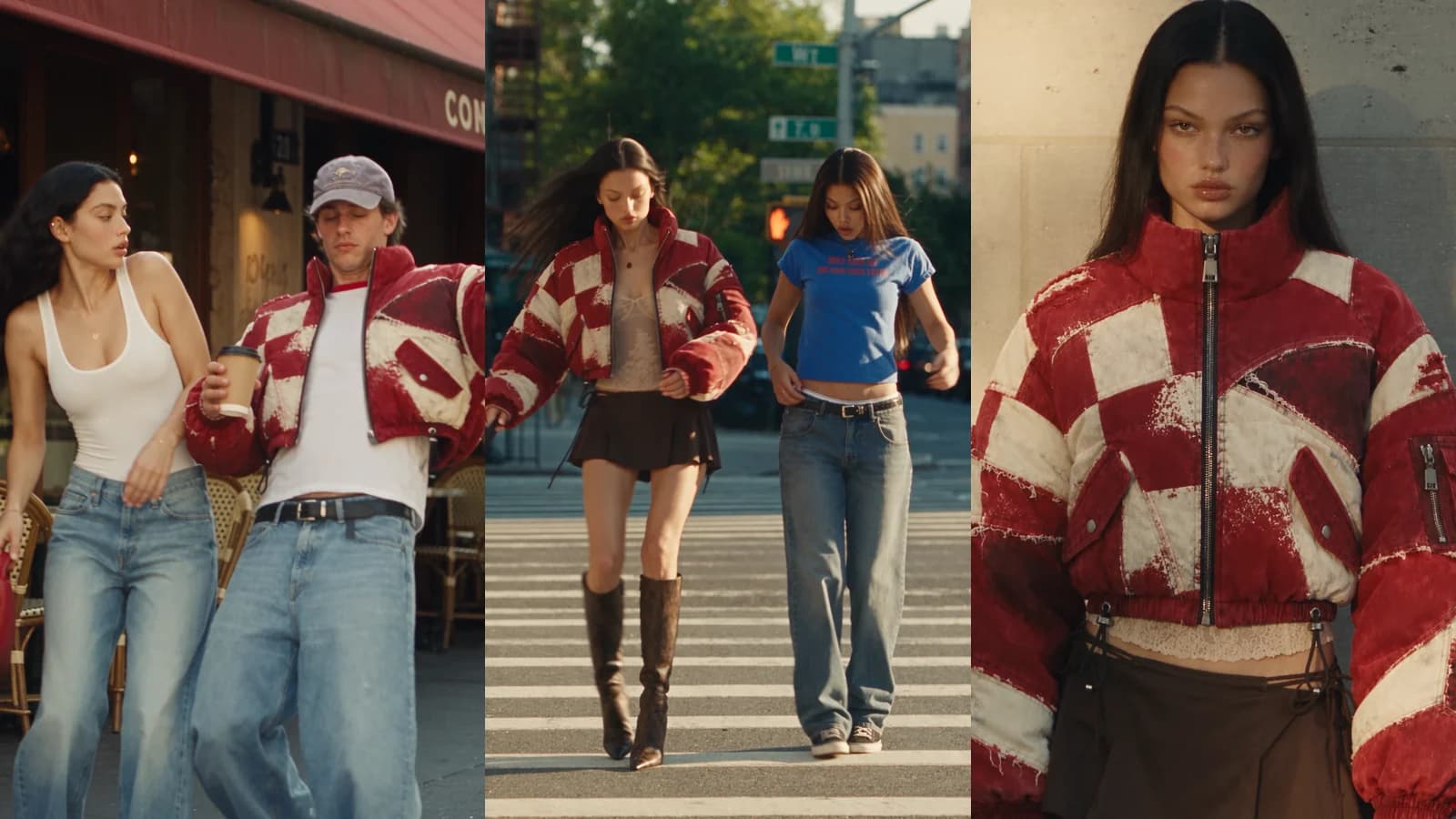
This clip is eighteen seconds of one jacket changing owners four times on a city street, and it was made from a product photo, five model references and one prompt. Seedance 2.5, 9:16, 1080p, audio on, no input video, 5,940 credits. Each hand-off is written as its own three-second scene, and the model kept one garment, five identities and a purple cap straight for the full run.
What Was Set
| Setting | Value |
|---|---|
| Model | Seedance 2.5 |
| Mode | Image references to video, no input video |
| Resolution | 1080p (1080 × 1920) |
| Aspect ratio | 9:16 |
| Duration | 18 seconds |
| Audio | On: footsteps, skateboard wheels, street, fabric |
| Reference images | 6 (1 jacket, 5 models) |
| Prompt length | 1,814 words |
| Credits | 5,940 |
Everything else is in the prompt.
What Goes In: One Product, Five Models
The jacket reference is a flat product shot: cropped, red-and-cream distressed check, upright collar, two-way zip, flap pockets, a zip on the left sleeve, elastic hem with toggles.

The five people are five separate images, each a full-length studio shot on a plain background. One of them is a four-view collage of the same woman, which the prompt names as such so the model does not read it as four people.

Seedance 2.5 takes all six at once. What tells it which image is the jacket and which are the wearers is the prompt, which describes every reference in one line by what it wears, white T-shirt with red neckline, light-blue baggy jeans, faded dusty-purple cap, and then gives each one a letter. From then on the scenes say B, not "the man with the coffee".
How the Prompt Is Built
The prompt is 1,814 words, and almost all of that length is rules rather than description. It has five parts.
Concept, in two sentences. One jacket switches between five people when their shoulders bump. When it lands, it pulls the new wearer's shoulders back.
References and cast, once. The jacket paragraph lists every detail to preserve and ends with it is not a hoodie, do not add a hood. Then the five people, one line each, with a letter.
The transfer rule. Only one jacket exists. The order is A → B → C → D → E. After each transfer the previous wearer is back in their original outfit. Shirts, trousers, bags, hats and coffee stay with their owners. This block is what stops the model from swapping outfits or minting a second jacket.
The body pull, as physics. Shoulders back, chest up, torso leans, chin lifts, arms loosen, knees soften, then forward again. Written as one connected motion, with the note that it must not start before the jacket arrives. The outgoing wearer gets a smaller counter-twist.
Five scenes with second ranges. 0–3, 3–6, 6–9, 9–12, then 12–18 for the showcase. Each scene names the location, who starts with the jacket, who approaches, the bump, the pull, the look-down, the puzzled glance back, and ends with CUT TO THE NEXT SCENE.
After that comes a fit block about sleeves and cuffs, a paragraph just for the cap, the film look, the camera, the sound, and a final checklist. The checklist repeats the rules a third time. That repetition is not padding: it is the reason the cast, the order and the cap held.
Scene by Scene

0–3 seconds. Outside a café. A wears the jacket over her white tank; B walks up in the purple cap with a takeaway coffee. They bump, the jacket lands on him, and his head snaps back with the pull. She checks her bare shoulders. His coffee never tilts.

3–6 seconds. B, now in the jacket, passes C coasting on his skateboard. The bump puts the jacket on C mid-roll; his arms fly out for balance and both feet stay on the deck, as the prompt asks. B is back in the white-and-red tee, still holding the coffee, still in the cap.

6–9 seconds. Beside a stone wall, C rolls past D in her blue tee. Her shoulders pull back, she takes one recovery step and touches the jacket's chest. C keeps rolling in his black-over-white layers.

9–12 seconds. A pedestrian crossing. D hands off to E, whose hair swings with the pull, exactly the detail the prompt asked for. D looks down at her restored blue tee. E looks down at a jacket she did not put on.

12–18 seconds. E against a pale stone wall: full-body front, then a medium on the collar, zip and pockets, then a rear three-quarter with an over-the-shoulder look. Three shots in six seconds, all as written, and the jacket reads as the same garment from the product photo in every one.

The Pull, Frame by Frame
The backward pull is the whole trick of the clip, and the prompt spends 200 words on it. Here is the first hand-off at 0.75, 1.0 and 1.5 seconds.

At 0.75 seconds A wears the jacket and B is still in his tee. At 1.0 the jacket is in motion and B's head is thrown back. At 1.5 he is upright, correctly dressed, both hands out through the cuffs, coffee still level. The whole transfer is around twelve frames. Describing the reaction as a chain of body parts, shoulders, chest, torso, chin, arms, knees, is what gets a physical response instead of a costume change.
Step-by-Step: Make One Yourself
Step 1: Shoot the product flat
One clean image of the garment on a plain background, front-on, with every detail you care about visible. This is the image the model copies onto each wearer. A photo on a mannequin or a hanger works; a photo on a person does not, because the model will bring the person too.
Step 2: Give each person one reference and one letter
One image per wearer, full-length, plain background. In the prompt, describe each by what they wear in one line and assign a letter. If a reference is a collage, say so. Keep the cast to five or fewer; every extra identity is another thing the model can confuse.
Step 3: Write the rule once, then the order
Only one garment exists. It moves on contact. The order is fixed. Everything else stays with its owner. Then say it again in the final checklist. The model does not mind repetition, and the second copy is the one that holds when the scene gets busy.
Step 4: Write each encounter as a three-second scene
Location, who has the jacket, who approaches, the bump, the pull, the reaction, cut. Give each scene its own second range and end it with a cut instruction so the model does not try to stitch one long take. The last wearer gets the long showcase: here, six seconds in three shots.
Step 5: Set it and render once
9:16, 18 seconds, 1080p, audio on, six references attached, input video empty. Draft at 480p if you are not sure the order will hold, 1,062 credits, and render the final at 1080p once it does.
The Full Prompt
Copy gives you the prompt exactly as it was sent. Recreate opens it in the video generator with Seedance 2.5 selected; attach your own jacket and cast.
What It Costs
Seedance 2.5 is priced per second of output, and the rate changes with resolution. Eighteen seconds at each tier:
| Resolution | Credits per second | 18-second clip |
|---|---|---|
| 480p | 59 | 1,062 |
| 720p | 132 | 2,376 |
| 1080p | 330 | 5,940 |
Six reference images cost nothing extra; the price is the output, not the input. Which is the argument for a 480p draft on a prompt like this one: the thing most likely to go wrong is the order of the hand-offs, and that is visible at any resolution for 1,062 credits.
Where It Fell Short
Three things did not arrive exactly as written, and none of them reads at full speed.
The zip is open. The prompt says keep the zipper closed while the jacket is worn. On A, B, C and D it is open, with their own shirt showing underneath, and it only closes for E's showcase. The model chose the version that lets the outgoing wearer's restored shirt read at a glance, which is the more important instruction, and dropped the one that conflicted with it. If a closed front matters, take the shirt-check beat out.
The T-shirt slogan is not words. D's blue tee has printed text in the reference. In the film the print is there, in the right place and colour, but it is letter-shaped marks rather than the actual words. Video models still do not reproduce small text reliably; a garment whose print is the point should be shot closer or kept still.
Four frames of two wearers. At each bump there is a run of about four frames where the jacket is on both people at once: the fabric flutter the prompt asks for, taken literally. At 24 frames a second it is a sixth of a second and reads as motion blur. Frame by frame it is a double jacket. The prompt's only one jacket exists holds everywhere else.
Where You Still Regenerate
A prompt this specific gets the structure right the first time: the order, the cap, the coffee, the showcase. It does not make the render deterministic. Run it again and the café will be a different café, the crossing a different crossing, and the pull will land a few frames earlier or later. If a particular frame matters: the exact over-the-shoulder look for a thumbnail, say: that is a second render at 480p to find it, then one at 1080p, not an edit.
Try It
Press Recreate on the prompt above. Swap the jacket for your own garment, rewrite the JACKET paragraph, keep the cast and the scenes, and start at 480p.
- #Seedance2.5
- #AIFashionFilm
- #ProductVideoAI
- #MultipleReferenceImagesVideo
- #ConsistentCharacterAIVideo
- #AIStreetwearVideo
- #9:16AIVideo
- #AIVideoPromptExample
- #Gendia
Got any questions left?
Six. One product photo of the jacket and five model images, one of which is a four-view collage of the same woman. Seedance 2.5 accepts them together and the prompt tells it which is which.
5,940 credits, 330 per output second at 1080p, times eighteen seconds. The same clip at 720p is 2,376 credits and at 480p is 1,062. Draft at 480p to check the order of the hand-offs, then render once at 1080p.
Yes. The red-and-cream check, the distressed edges, the two-way zip, the flap pockets, the sleeve zip and the elastic hem are all on every wearer. The only thing that varies is how the panels fall on a different body.
Yes. Nobody else's shirt, jeans, bag, cap or coffee moved. The prompt says so three separate times, and that repetition is why it held.
Three small places. The zip is open on the first four wearers although the prompt asks for it closed, the slogan on the blue T-shirt came out as letter-shaped marks rather than words, and for about four frames at each bump the jacket is on both people at once. None of them reads as an error at full speed.
Yes. Press Recreate, swap the jacket image for your own garment, rewrite the JACKET paragraph to describe it, and keep the cast and the scenes. Anything worn on the upper body works with the prompt as written.