We use cookies and similar technologies to improve your experience, analyze usage, and measure the effectiveness of our advertising. See our Privacy Policy, Terms, and Cookie Policy.
Case Studies14 min read
How the Stop-Motion Posts Were Made: Both Prompts, Start to Finish
The paper cutout and felt stop-motion clips from Instagram, broken down. Every still made with GPT Image 2, every animation with Seedance 2.5, and both prompts printed in full so you can rebuild them.
The Instagram clips were made in two steps, not one. A still first, then the animation, two different models, two different prompts.
Here is the whole thing, both prompts printed in full, for all five clips.
The workflow
Step one: make the scene as a still. GPT Image 2, a top-down flat lay, every paper or felt piece described along with the shadow it casts. This is the set.
Step two: animate that still. Seedance 2.5, with the still attached as the reference image, and a prompt that describes only what moves. The look is already locked by the image: the video prompt never re-describes the palette or the materials.
Attaching the picture is not optional. The video prompts below say things like "the elements from the reference image then appear one at a time", paste one on its own, with no image, and you get nothing.
That split is the whole trick. Trying to get both the craft look and the motion out of one video prompt gives you neither.
1. The music desk
The densest of the five, and the one that shows what the format is for: the video starts on an empty sheet and the pieces arrive one by one.
The still, GPT Image 2
Vertical 9:16 image, top-down flat lay, photorealistic paper cutout collage filling the entire frame. A dense layered scene built entirely from hand-cut construction paper: at the center, a large record player made of stacked paper shapes — a walnut-brown rectangular base, a black circular vinyl disc with concentric cut rings, a thin tonearm, a small red label at the center. Radiating outward and filling the rest of the frame: a coffee cup with three wavy steam strips, an open book with layered page shapes, a small potted plant with eight separate cut leaves, a stack of three paper albums, a wall clock, a pair of headphones, a table lamp with a triangular shade, five scattered musical notes, a cluster of small stars and dots, and a few thin confetti strips. Every piece has visibly hand-cut uneven scissor edges, matte paper texture, and casts its own soft drop shadow onto the layer below, giving a deeply stacked physical look. Shot straight down from directly above, soft even daylight from the upper left, warm cream paper background, rich muted craft palette of terracotta, mustard, sage, dusty blue and cream, balanced composition with small gaps of background showing through, no text.
Paper pieces appearing one at a time to build the music scene
Vertical 9:16, 8 seconds, stop motion paper cutout animation. Start on the completely empty cream paper background. Hand-cut paper pieces appear one by one, popping into place with a snappy jittery motion — no fading, no sliding, each piece just lands. Small scattered confetti strips, stars and dots come first around the edges, then the surrounding objects assemble one at a time: the coffee cup with its steam strips, the open book, the potted plant leaves, the album stack, the clock, the headphones, the lamp. Finally the record player builds at the center from the bottom up — base, then the black vinyl disc, then the red label, then the tonearm dropping into place last. The finished composition holds still for the final second while the steam strips and musical notes keep twitching in place. Choppy low frame rate handmade stop motion feel, every piece shifting two or three pixels between frames as if placed by hand. Camera locked straight down from directly above, completely static, no zoom, no pan, no rotation. Lighting and background stay identical throughout.
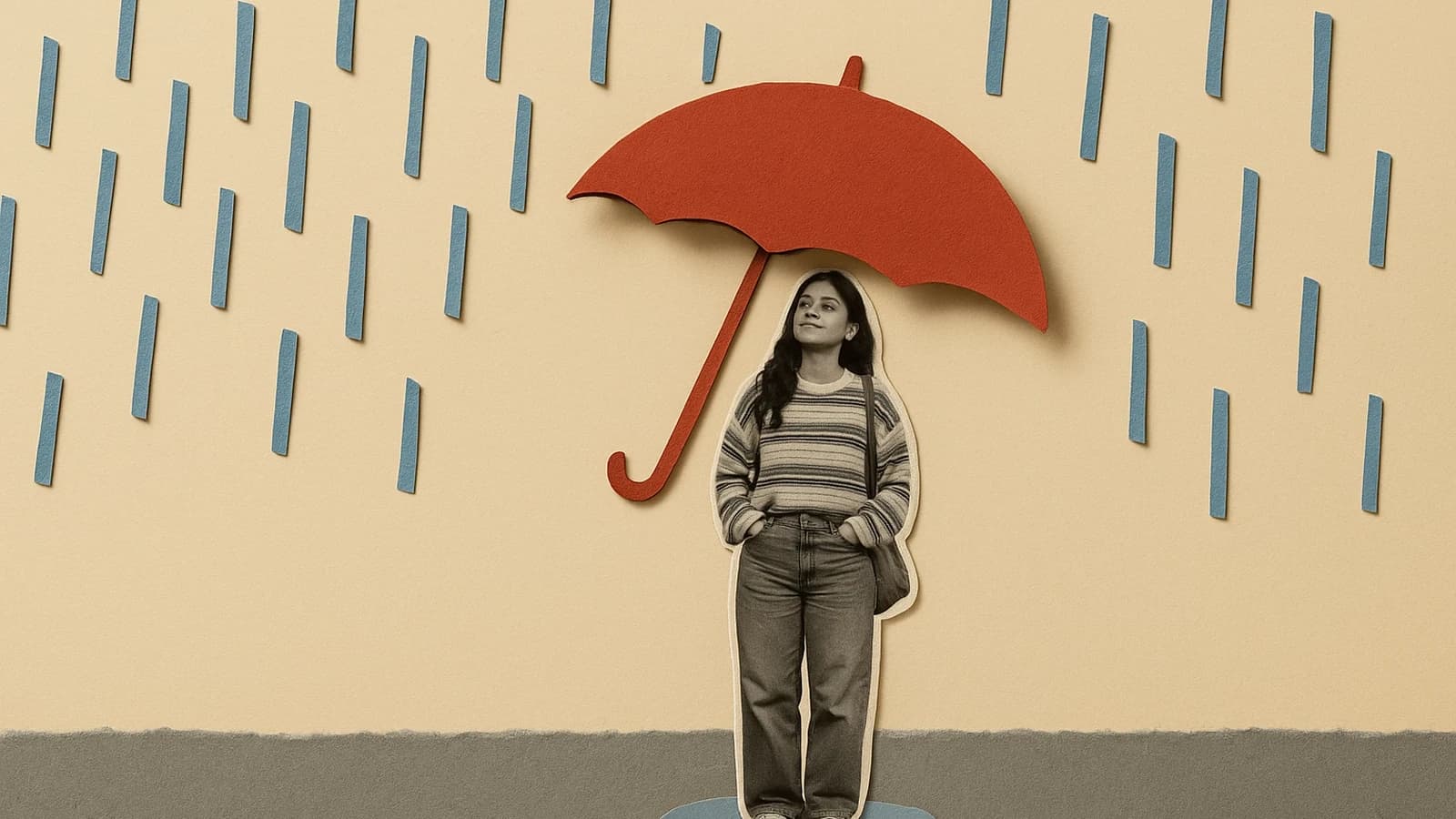
Fewer elements, and better for it. The order of arrival is doing the storytelling: the rain lands before the umbrella does.
The still, GPT Image 2
Vertical 9:16 image, top-down flat lay, photorealistic paper cutout collage on a flat warm cream paper background. A narrative scene made of only a few strong elements: at the center, a cut-out black and white photograph of a woman standing, torn roughly from a magazine page with visible ragged white edges. Above her, a large solid-color paper umbrella in deep terracotta red, hand-cut with slightly uneven scissor edges, tilted at an angle and casting a soft drop shadow over her. Falling from the top of the frame, about fifteen thin vertical strips of dusty blue paper as rain, cut in varying lengths and angled slightly, stopping where they meet the umbrella. Below her feet, one wide grey paper strip as the ground and two small pale puddle shapes. Generous empty cream background around the composition. Every piece has matte paper texture and its own soft drop shadow, giving a physically layered stop-motion look. Shot straight down from directly above, soft even daylight from the upper left, restrained palette of terracotta, dusty blue, grey and cream, no text.
Rain, then a figure, then a red umbrella arriving over her
Vertical 9:16, 5 seconds, stop motion paper cutout animation. Begin on a completely empty cream paper background with nothing on it. The elements from the reference image then appear one at a time in quick succession, popping into place with a snappy jittery motion — no fading, no sliding, each piece simply lands. First the grey ground strip and puddle shapes at the bottom, then the torn-out photograph of the woman dropping into the center, then the thin blue paper rain strips falling in rapidly from the top and landing on her. Finally the terracotta paper umbrella snaps into place above her head and the rain now stops at the umbrella instead of reaching her. The finished composition holds still for the final half second while the rain strips keep twitching in place. Fast-paced, choppy low frame rate handmade stop motion feel, every piece shifting two or three pixels between frames as if placed by hand. Camera locked straight down from directly above, completely static, no zoom, no pan, no rotation. Lighting and background stay identical throughout.
Same idea in a different material. Wool felt with visible fibre edges and embroidery thread, on a blanket that ripples slightly as each piece lands.
The still, GPT Image 2
Vertical 9:16 image, top-down flat lay, photorealistic craft scene on a soft oatmeal wool blanket background. At the lower center, a small figure cut from thick beige wool felt with visible fuzzy fiber edges, arms reaching upward. Rising from them, a ladder made of two dusty pink felt strips and six short rungs hand-stitched with visible white embroidery thread. At the top, one large mustard felt star and three smaller ones, with loose thread ends trailing. Everything sits on a soft textile surface with gentle fabric wrinkles. Warm diffused window light, very soft shadows, cozy handmade tactile feel, muted pastel palette, no text.
Felt pieces settling into place one at a time on a wool blanket
Vertical 9:16, 5 seconds, stop motion felt craft animation. Begin on the empty oatmeal wool blanket background with nothing on it, gentle fabric wrinkles visible. The felt elements from the reference image then settle into place one at a time with a soft nudged motion — no fading, no sliding, each piece simply appears as if placed by hand. First the dusty pink ladder lays down at the center. Then the beige felt figure arrives at the bottom, arms reaching up. Then the three small mustard stars pop in around the upper area, their loose gold threads trailing and curling as they land. Finally the large stitched star settles at the very top. The finished composition holds for the last half second while the loose embroidery threads keep gently twitching and shifting. Slow warm choppy low frame rate stop motion, every piece shifting two or three pixels between frames as if nudged by fingers, the soft wool blanket underneath subtly rippling with each placement. Warm diffused window light with very soft shadows throughout. Camera locked straight down from directly above, completely static, no zoom, no pan, no rotation. Lighting and background stay identical from start to finish.
This is the one worth studying. Identical still, completely different video prompt, and it turns a build into a story.
The still, GPT Image 2
Vertical 9:16 image, top-down flat lay, photorealistic craft scene on a soft oatmeal wool blanket background. At the lower center, a small figure cut from thick beige wool felt with visible fuzzy fiber edges, arms reaching upward. Rising from them, a ladder made of two dusty pink felt strips and six short rungs hand-stitched with visible white embroidery thread. At the top, one large mustard felt star and three smaller ones, with loose thread ends trailing. Everything sits on a soft textile surface with gentle fabric wrinkles. Warm diffused window light, very soft shadows, cozy handmade tactile feel, muted pastel palette, no text.
The felt figure climbing the ladder rung by rung toward the star
Vertical 9:16, 5 seconds, stop-motion felt craft animation. Use the reference image as the exact visual setup: oatmeal wool blanket background, dusty pink felt ladder in the center, beige felt figure at the bottom, three small mustard felt stars around the upper area, and one large stitched mustard star at the very top.

The full composition is already assembled from the first frame. The beige felt figure actively climbs the ladder upward toward the large star during the entire 5-second shot. Animate the figure one rung at a time in handmade stop-motion: one hand reaches up, the body lifts slightly, one foot moves onto the next rung, then the other hand and foot follow. The figure should make 3–4 clear climbing movements, gradually traveling from the bottom of the ladder to near the top by the final frame.

Keep the ladder and stars fixed in their original positions. Only the felt figure moves upward, with tiny imperfect 2–3 pixel shifts between frames as if physically repositioned by hand. The figure should stay flat against the blanket like a real felt cutout, never becoming 3D or bending unnaturally. Its arms and legs can rotate slightly between frames to create the climbing action.

The loose embroidery threads around the stars gently twitch and curl throughout, and the wool blanket subtly compresses and ripples whenever the figure changes position. Slow, warm, slightly choppy low-frame-rate stop motion, tactile handmade feeling.

By the final 0.5 seconds, the figure reaches the uppermost rung and stretches one arm toward the large mustard star. Hold this final reaching pose while the loose threads continue making tiny movements.

Warm diffused window light, very soft natural shadows. Camera locked straight down from directly above, completely static. No zoom, no pan, no rotation, no camera shake. Background, lighting, ladder, and stars remain identical from start to finish. No fading, no morphing, no sliding animation, no smooth digital motion.
The loudest of the set, and the only one on black paper. Same construction as the others - torn pieces on a flat background - but the palette does all the work.
The still, GPT Image 2
Vertical 9:16 image, top-down flat lay, photorealistic ransom-note style collage on a black paper background. At the center, a cut-out black and white photograph of a person mid-stride, ripped harshly from newsprint with frayed torn edges. In front of them, a wall built from overlapping glossy magazine scraps in clashing neon pink, electric green and orange, with a jagged hole blasted through it and torn fragments flying outward. Halftone dot texture visible on every printed piece, some scraps upside down, edges deliberately messy and misaligned. Harsh direct flash lighting from above with hard sharp shadows, high contrast, chaotic punk zine energy, no text.
Neon scraps blasting outward as the figure breaks through
Vertical 9:16, 5 seconds, stop motion paper collage animation. Begin on a completely empty black paper background with nothing on it. The elements from the reference image then slam into place one after another in rapid succession — no fading, no sliding, each piece just hits the frame hard. First a scattering of neon pink, green and orange torn scraps land around the edges, then more pile inward layer over layer, building up fast and messy. Then the black and white cut-out figure drops into the center. On impact the surrounding scraps burst outward a step, jolting into their final radiating positions. The finished composition holds for the last half second while the outer fragments keep twitching and vibrating in place. Aggressive fast-paced choppy low frame rate stop motion, every piece jumping three or four pixels between frames as if slapped down by hand, harsh direct flash lighting with hard sharp shadows throughout. Camera locked straight down from directly above, completely static, no zoom, no pan, no rotation. Background and lighting stay identical from start to finish.
Clip 3 starts on an empty blanket and has the pieces arrive. Clip 4 says the composition is already assembled in frame one, and only the figure moves, climbing rung by rung, three or four clear movements, reaching the top by the final frame.
One is a build. The other is a story. If your clip feels like a product demo when you wanted a moment, that is usually the difference.
The five phrases doing the work
Pulled from the video prompts above, these are the ones you should carry into your own:
stop motion, low frame rate, choppy, without these it renders as smooth CG and the craft illusion dies
every piece shifting two or three pixels between frames as if nudged by fingers: the single most important line. Stop motion reads as handmade because it is imperfect, and you have to ask for the imperfection
camera locked straight down from directly above, completely static, any camera move breaks the flat-lay illusion
the soft wool blanket underneath subtly rippling with each placement, physical consequence. The surface reacting to the object is what sells the weight
no fading, no sliding, each piece simply appears as if placed by hand, naming the transitions you don't want, because the default is a crossfade
What it took
The felt prompt did not work first time, and not on the first model.
Model
Result
Runs
Kling 3.0
failed
9
Seedance 2.5
completed
2
Hailuo 2.3
completed
1
Nine failed runs on Kling 3.0 before Seedance 2.5 produced it. That is worth knowing before you assume a prompt is wrong, sometimes it is the model. If a stop-motion prompt keeps failing, switch models before you rewrite it.
All five finished clips are 5 seconds, 720p, 9:16, audio on, except the music desk, which is 8 seconds because it has the most pieces to place.
Doing it yourself
1. Write the still prompt like a materials list. Name the paper or the felt, the colour of each piece, the hand-cut edges and the drop shadow each one casts. The shadow is what makes it look photographed rather than illustrated.
2. Generate the still and keep it.Start here with GPT Image 2.
3. Feed that still to Seedance 2.5. As a reference image for motion inside a finished scene, or as the last frame with a blank sheet first if you want the scene to build itself.
4. Write motion only. What appears, in what order, how the surface reacts. Never re-describe the look.
5. Ask for stop-motion imperfection explicitly. The five phrases above.
Try it
Everything here was made in Gendia, both models, one login. Copy an image prompt, swap the objects for yours, then copy the matching video prompt and change what moves.